November 2026
I Used to Think Like That
Mustafa wanted to automate more of our venue pipeline than I was expecting. It reminded me that I used to think like that too.
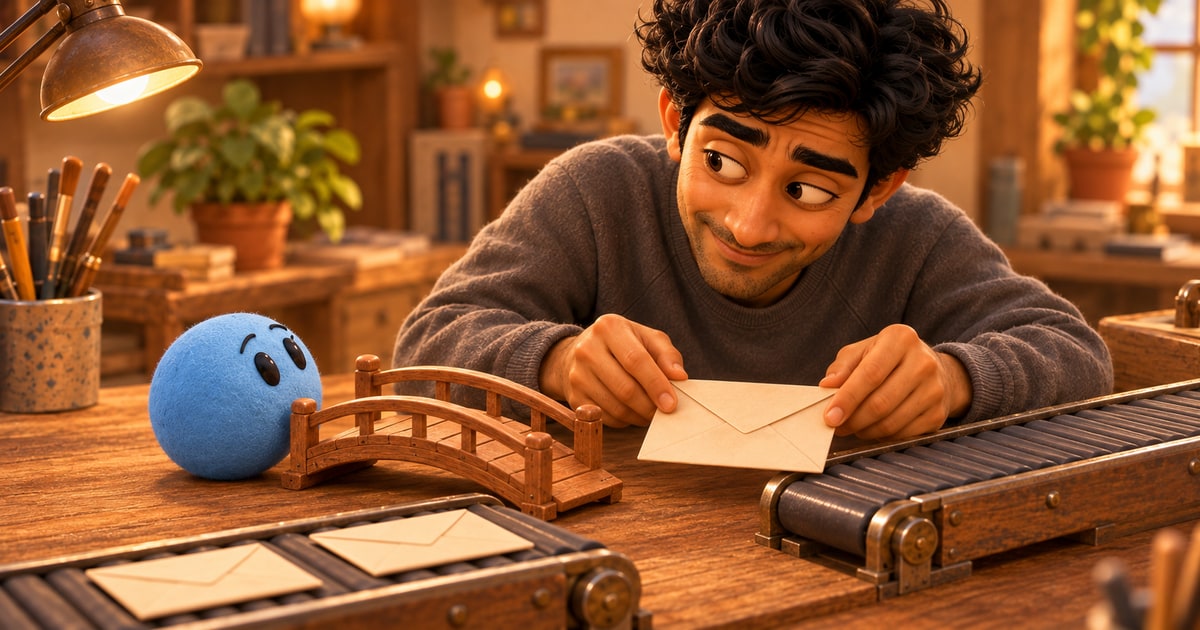
I’ve started working with Mustafa on our jewellery business. He’s younger than me and has spent six years in e-commerce, which is experience I don’t have.
We’re starting with events. People can see and try the jewellery. We get good feedback, and there’s already money coming in. We want a system that makes the work repeatable and helps us delegate sales well.
Mustafa’s instinct was to automate more of it than I was expecting.
I can’t remember the exact conversation. I think we were talking about finding venues, scoring them commercially and drafting outreach. Maybe sending it too, doing the follow-ups, even coordinating bookings. I don’t remember where his proposal stopped or which of those bits we’ve actually got working yet.
But I remember the freshness.
Part of me was still assuming a human had to be the constraint somewhere in that pipeline. Did they?
I don’t know. We still have to find out how far we can take it.
The funny thing is that automating as much as possible used to be my instinct too.
Around seven years ago, I was building LinkedIn automation. Grey hat, getting towards black hat. Hundreds of bots in the cloud, testing messages and doing things automatically.
Then LinkedIn banned our accounts, and the business collapsed.
I’d spent months engineering something difficult without actually being an engineer. It taught me systems thinking and some basic technical skills. It was also a six-month mind fuck.
Maybe that experience pulled me away from automation more than I realise. I don’t know how much of my caution comes from that.
Now we’ve got large language models. I look at some of the things that were so painful to build and wonder how quickly we could get them working today.
And the spirit of Mustafa’s approach was: well, fucking automate.
I was thinking: yeah, motherfucker. Actually, why not?
There are things to work out. What needs a human relationship? What needs trust or judgment? What should come back to us for a decision? How do we keep the experience feeling human for the customer?
I assume being able to evaluate what comes back is going to matter quite a lot.
But I’d been carrying an assumption about where a person had to sit before we’d really examined it.
That’s what his freshness caught.
I wondered whether some of it was age. Maybe at 32 I’m more fixed in certain ways than I think. I consider myself pretty open, so it’s interesting to notice.
He also has experience I don’t. I have things I’ve learned that are useful. I quite like the combination.
I’m getting better at being scrappy. I used to be terrible at it. My instinct was to build a robust, nearly complete system, which could take ages and be painful to get working.
A bit of that freshness helps.
Thank you, Mustafa. You’ve made me reconsider how dogmatic I am about work.